Super Credit Fix Logo - Financial Freedom Simplified Start
← Back to Diagnostic Hub

The **5 FICO Factors** That Control Your Score

This guide breaks down the FICO formula. Understanding these five areas is the foundational key to any serious, successful credit repair attempt.

What is a FICO Score?

A credit score is a three-digit number, typically ranging from 300 to 850, that summarizes how risky you look to lenders based on your past and current borrowing behavior. It is designed to predict how likely you are to pay back debts on time.

The **“FICO score”** is the most widely used brand, created by the Fair Isaac Corporation. While various models exist (like VantageScore), FICO is the standard most major lenders rely on when deciding whether to approve you and what terms to offer.
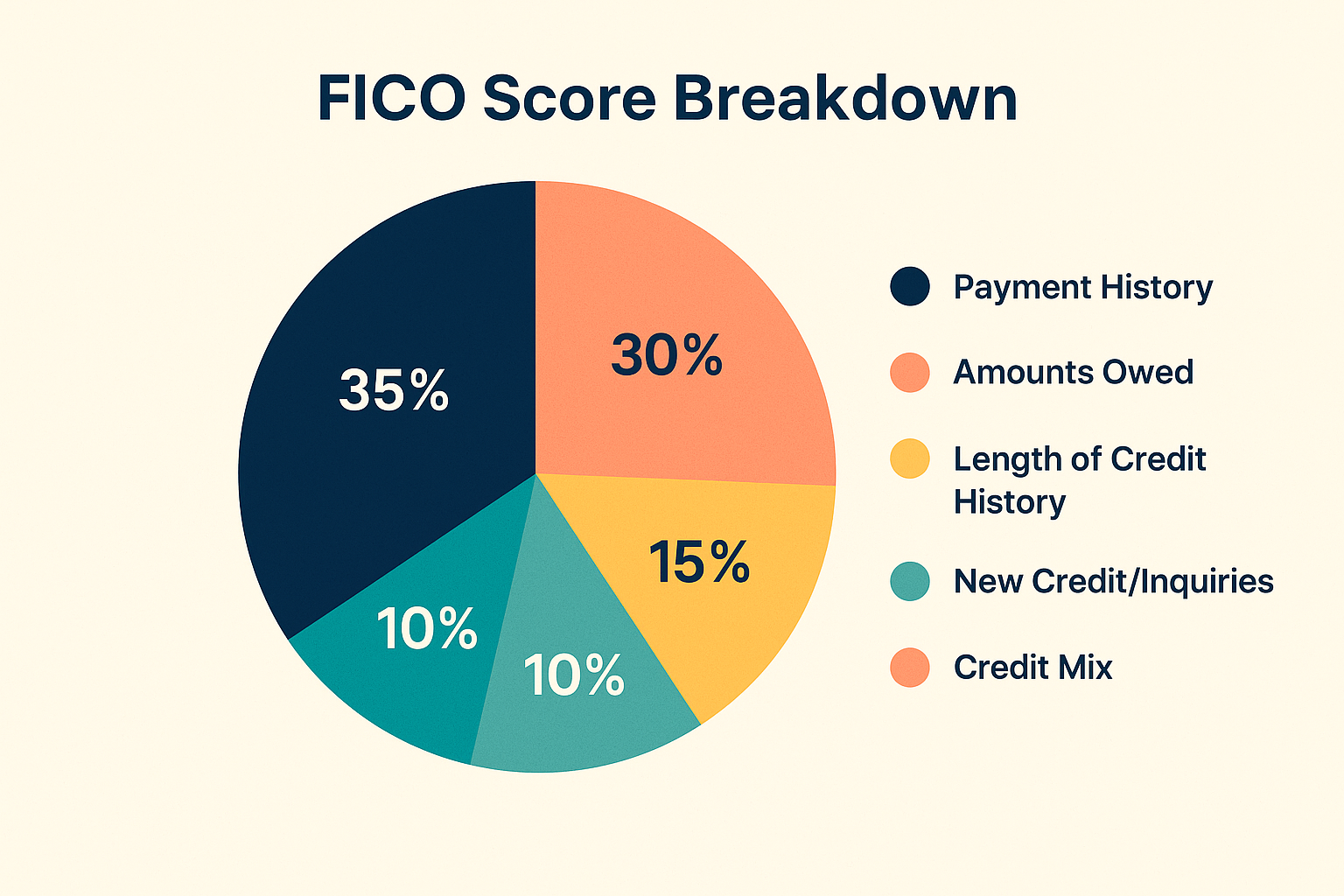
The 5 FICO Factors and Their Weights

FICO Score Pie Chart showing 35% Payment History, 30% Amounts Owed, 15% Length of History, 10% New Credit, 10% Credit Mix

If you want to know why your score is low or how to fix it, these are the five critical areas to focus on.

  • Payment History 35%
  • Amounts Owed (Utilization) 30%
  • Length of Credit History 15%
  • New Credit / Inquiries 10%
  • Credit Mix 10%

1. Payment History (about 35%)

This is the most important factor. It answers a simple question: Do you pay your bills on time? This includes credit cards, mortgages, student loans, and car loans.

  • A long streak of **on-time payments** is the most effective way to boost your score.
  • Even a single payment that is 30 days late can hurt your score hard.
  • The more recent the problem (missed payment, collection, bankruptcy), the more damage it does.

2. Amounts Owed / Credit Utilization (about 30%)

This measures how much of your available credit you are using. This is called your **credit utilization ratio** (Total Balances ÷ Total Limits).

  • **The Golden Rule:** Keep your utilization under **30%** on revolving accounts (credit cards).
  • Lower is better! If you keep it below 10%, your score can jump fast.
  • **Pro Tip:** Pay your credit card bill before the statement posts, so less gets reported to the credit bureaus.

3. Length of Credit History (about 15%)

FICO looks at the age of your oldest account, your newest account, and the average age of all your accounts. Longer history shows more experience and responsibility.

  • Do not close old accounts, even if you don't use them, as this can drop your average age.
  • If you are starting out, manage new accounts well, but reaching the top tier takes years, not months.

4. New Credit / Hard Inquiries (about 10%)

This reflects how often you apply for new credit. Each application results in a **“hard inquiry”** that can slightly lower your score for a short time.

  • A cluster of inquiries (e.g., for new credit cards) in a short time is seen as risky.
  • **Rate Shopping Loophole:** When shopping for a mortgage, auto, or student loan, multiple inquiries in a short window are usually treated as a single inquiry.

5. Credit Mix (about 10%)

FICO likes to see that you can handle different types of credit: **revolving credit** (like credit cards) and **installment credit** (like mortgages or auto loans).

  • People who juggle both cards and loans responsibly score a bit higher.
  • **Warning:** Do not open a new account just to improve your credit mix. It’s not worth the risk.

What's Next? Check Your FICO Score Now

Understanding the FICO formula is only half the battle. Your next step is to find out your current score and pull your reports to identify the exact items holding you back.

Grab the Tools That Force Action

Don't wait for errors to disappear. Get the **Ultimate Dispute Letter Kit** to start challenging items immediately after finding them in your report.

Download FREE Dispute Templates